South Carolina Font: Minimalist Script for Handmade Branding
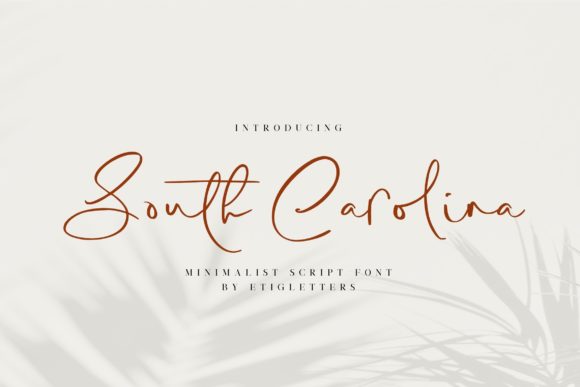
There’s a quiet magic in the moment you type “Honey Lavender” into your candle label mockup—and watch South Carolina flow across the screen like ink dipped in sunlight. That’s when it clicks: this Script Handwritten font isn’t just another set of glyphs—it’s the soft, confident voice your handmade brand has been waiting to speak with. As a maker who designs labels, prints planner pages, and hand-assembles wedding welcome boards, I reach for South Carolina when I need elegance that feels effortless, not overworked.
South Carolina for Candle Labels and Natural Product Packaging
South Carolina shines brightest where authenticity matters—like soy candle jars wrapped in kraft paper or small-batch soap boxes tied with twine. Its natural cursive style carries warmth without fuss: no exaggerated swashes, no forced drama—just gentle entry and exit strokes that echo handwriting made with care. When used at 14–18pt on matte sticker stock, the letterforms hold crispness through printing and cutting (tested on Cricut Maker and Silhouette Cameo). For best readability on 1”–2” labels, stick to short names (“Sage & Sea,” “Dusk Pine”) or single-word scent titles. Pair South Carolina with a clean sans serif—think Montserrat Light or Inter Regular—for ingredient lists or batch numbers. As a Fonts choice for product packaging, it signals artisan quality before the jar is even opened.
South Carolina for Wedding Invitations and Elegant Branding
When designing a suite for a spring garden wedding—or drafting a digital invitation preview for a client—I open South Carolina first. Its minimalist script balances romance and restraint: the lowercase “y” curls just enough, the capital “S” rises with quiet authority, and spacing stays generous—no cramped letters fighting for air. It works beautifully for names, dates, and ceremony locations, especially when layered over watercolor textures or linen-textured backgrounds. Because South Carolina is a true Script Handwritten typeface—not a calligraphic simulation—it avoids looking stiff or overly formal. Use it for main headers only; pair with a simple serif (like Lora or Playfair Display) for body text. Always check included ligatures and alternate characters—some versions offer subtle flourishes perfect for monograms or envelope addressing.
South Carolina for Greeting Cards and Hand-Stamped Stationery
I printed a dozen birthday cards last week using South Carolina for the front sentiment (“You’re One of a Kind”) and a light-weight sans for the inside message. The contrast felt intentional, not accidental—the kind of detail customers notice when they pause mid-unfold. As a Fonts option for greeting cards, South Carolina performs well at 20–28pt on 300gsm cardstock, with excellent legibility even in softer ink tones (tested with muted sage, dusty rose, and charcoal gray). For hand-stamped stationery, its smooth baseline and consistent stroke weight translate cleanly to rubber stamp carving—no thin hairlines that vanish under pressure. Just avoid dense blocks of text; South Carolina is a display font, not a paragraph workhorse.
South Carolina for Printable Wall Art and Planner Pages
My latest printable wall art set—“Slow Mornings,” “Breathe Deeply,” “Make Space”—came alive the second I swapped in South Carolina. Its natural cursive rhythm gives each phrase breathing room and emotional weight. On digital downloads, it renders cleanly at high resolution, whether viewed on an iPad planner or printed at 12x16”. For weekly planner headers, I use South Carolina at 16pt bold (if available) or duplicate the layer with a 0.5pt stroke for subtle emphasis. Since many makers sell these as commercial-use templates, always verify the license covers digital resale—most reputable Script Handwritten fonts do, but double-check file formats (OTF/TTF/WOFF), multilingual glyphs, and commercial permissions before listing.
South Carolina for Boutique Tags and Seasonal Product Labels
Mini tags for handmade soaps, holiday ornaments, or summer herb bundles? South Carolina fits. At 10–12pt on 1.5” round kraft tags, it remains legible while keeping that handmade charm intact. I tested it on laser-printed vellum and thermal receipt paper—both held the curves gracefully. For seasonal products (think “Pumpkin Spice,” “Winter Solstice,” “Lemon Verbena”), South Carolina adds a personal, sunlit tone without leaning into cliché. Unlike bolder script fonts, it doesn’t overwhelm delicate packaging—it complements it. And because it’s designed as a Fonts family with balanced metrics, scaling up for a wooden sign (“Welcome Home”) or down for a tea bag tag feels consistent, not jarring.
South Carolina for Tote Bags, Mugs, and Shop Signage
When heat-pressing a canvas tote with “Good Things Take Time,” I chose South Carolina for its smooth vector paths—no pixelation, no fragile terminals snapping off during transfer. Same goes for ceramic mugs: the font’s open counters and moderate contrast survive sublimation well, especially when outlined or paired with a subtle shadow. For physical shop signage or farmhouse-style wood signs, size South Carolina generously (36pt minimum) and kern carefully—its natural cursive flow means some letter pairs (like “To” or “We”) benefit from slight manual adjustment. As a Script Handwritten option, it bridges rustic and refined—ideal if your brand lives somewhere between cottagecore and modern minimalism.
How to Use South Carolina With Confidence Across Your Creative Work
- Best for: Short phrases, names, titles, decorative headers, and display use—not long paragraphs or fine print.
- Pair wisely: A neutral sans (Inter, Poppins) or soft serif (Cormorant Garamond) creates balance and hierarchy.
- Test before cutting: Load your SVG or DXF into design software and zoom to 400%—check for stray nodes or inconsistent line weights.
- Licensing note: Confirm commercial use rights cover physical products, digital templates, and resale—if you’re selling printable planners or SVG bundles, this matters.
- File formats: Prefer OTF for OpenType features (ligatures, alternates); TTF works reliably across most craft machines and platforms.